

 1 / 5
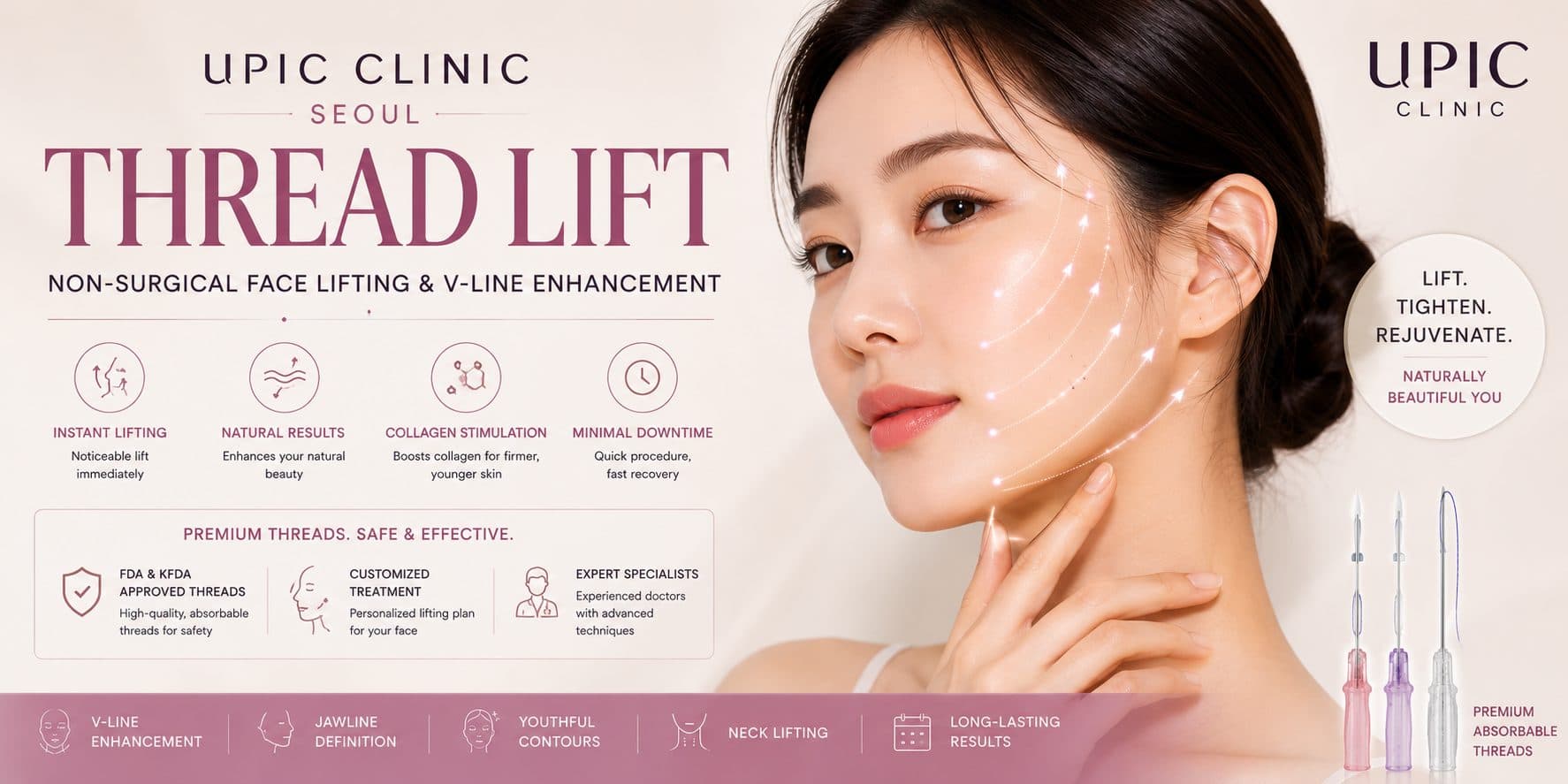
1 / 5Thread lift at UPIC Clinic Myeongdong is a minimally invasive aesthetic procedure in which threads are placed beneath the skin to support and reposition selected facial tissues.
UPIC Clinic offers several thread designs for different treatment goals and facial characteristics. The appropriate option depends on the location and degree of laxity, facial structure, skin condition, previous treatments and the amount of correction the patient expects.
Thread lifting is not equivalent to a surgical facelift. It generally produces a more limited and temporary change, and it cannot remove excess skin, alter facial bone structure or guarantee a particular V-line shape.
A consultation is required to confirm the treatment area, thread product, thread material, number of threads, practitioner, expected recovery and current price.
Fornur helps international visitors explore Skin & Aesthetic services in Korea and request consultations with available clinic partners. The consultation request is free. Thread-lift treatment is charged separately.
 Quick Answer
UPIC Clinic Myeongdong provides thread-lift treatment for selected facial concerns involving early laxity, reduced lower-face definition, sagging-looking cheeks and changes around the jawline.
The clinic currently describes several thread structures, including basic PDO threads, cog threads, tunnel-shaped threads and different barbed-thread designs. These options can differ in how they support, anchor or reposition tissue.
The correct thread cannot be selected from a package name alone. Facial anatomy, existing volume, tissue movement, previous fillers or threads and the intended degree of lifting all need to be assessed before treatment.
Thread lifting uses entry points rather than the larger incisions associated with facelift surgery. Threads are passed beneath the skin along a planned direction to support or reposition tissue in the treated area.
Barbed or cogged threads can provide mechanical support by engaging the surrounding tissue. Other thread structures may be selected where the intended goal involves a different balance of support, volume or skin-quality improvement.
The insertion of a thread also produces a healing response in the surrounding tissue. However, the degree of collagen-related change and its clinical importance vary between products, techniques and patients.
The result depends heavily on correct anatomical assessment and thread placement. A treatment described only as a “collagen thread lift” is not specific enough for informed consent.
UPIC Clinic Myeongdong currently describes several thread designs within its thread-lifting service.
Basic PDO threads and basic cog threads are listed for concerns involving elasticity and tissue support. The clinic also presents tunnel-shaped threads intended to provide a three-dimensional structure, three-direction barbed threads designed for stronger fixation and 360-degree barbed threads intended to provide multidirectional support.
These descriptions do not identify every commercial product, material or regulatory status. Before treatment, the clinic should identify:
The exact thread brand, material and design
The number of threads and areas being treated
The intended purpose of each thread
The practitioner performing the procedure
The anaesthetic and pain-management plan
The expected recovery, follow-up and complete price
A patient should not purchase a package based only on the words “full face,” “V-line” or “collagen lift” without knowing what the package contains.
Thread lifting is commonly discussed for early facial laxity, reduced jawline definition, early jowling, sagging-looking cheeks, nasolabial-fold concerns and changes in lower-face contour.
It can also form part of a broader treatment plan when facial volume loss, prominent cheek fat or skin-quality changes contribute to the person’s concern. In these cases, a thread lift alone may not address the underlying cause.
More pronounced laxity or substantial excess skin is unlikely to produce the same degree of correction as surgery. The consultation should explain whether thread lifting is proportionate to the concern or whether another approach is more appropriate.
A lower-face or jawline thread lift can reposition selected soft tissues and create a temporary change in facial definition.
It does not reduce the width of the jawbone, permanently remove facial fat or guarantee the narrow facial shape often described as a V-line. People with concerns involving jaw-muscle size, facial fat, skeletal structure or significant skin laxity may require a different assessment.
The clinic should explain which anatomical feature is creating the concern and what the proposed thread placement is intended to change.
The consultation should begin with an assessment of facial structure, asymmetry, skin thickness, tissue movement and the location of the laxity.
Previous thread lifts, dermal fillers, facial surgery and energy-based treatments can affect treatment planning. The clinic should also review medical conditions, allergies, prescribed medication, supplements, bleeding or healing problems and previous complications following aesthetic procedures.
Before agreeing to treatment, confirm the exact practitioner, thread product, number of threads, treatment area, anaesthetic method, expected result, likely recovery and process for managing a complication.
Do not stop prescribed medication solely to prepare for a cosmetic procedure. Medication changes should be discussed with the healthcare professional responsible for the prescription.
The face is assessed and marked according to the agreed treatment plan. The skin is then prepared, and local anaesthetic or another pain-management method may be used.
Threads are introduced through selected entry points and passed beneath the skin along a planned path. Their positioning and direction depend on the treatment area, facial anatomy, thread design and intended degree of support.
The practitioner should assess facial balance, entry points and the immediate tissue response before the patient leaves.
Appointment length varies according to the planning required, number of threads, anaesthetic, treatment areas and observation after the procedure. The previously published estimate of 30 to 60 minutes should not be treated as a guaranteed duration.
Some mechanical lifting can be visible shortly after treatment, but swelling, bruising and temporary asymmetry can distort the early appearance. The result is more appropriately assessed after the initial recovery has settled.
The amount of improvement differs between patients. Thread material, thread design, number and placement of threads, degree of laxity, skin characteristics, facial movement, healing and continuing ageing can all affect the outcome.
Long-term evidence for thread-lift durability remains limited. The previously published claim that results typically last 12 to 18 months should not be presented as a standard or guaranteed timeframe.
The consultation should establish when the result will be reviewed, what degree of change is realistic and what options are available if the result is uneven or does not meet the agreed treatment goal.
Some mechanical lifting can be visible shortly after treatment, but swelling, bruising and temporary asymmetry can distort the early appearance. The result is more appropriately assessed after the initial recovery has settled.
The amount of improvement differs between patients. Thread material, thread design, number and placement of threads, degree of laxity, skin characteristics, facial movement, healing and continuing ageing can all affect the outcome.
Long-term evidence for thread-lift durability remains limited. The previously published claim that results typically last 12 to 18 months should not be presented as a standard or guaranteed timeframe.
The consultation should establish when the result will be reviewed, what degree of change is realistic and what options are available if the result is uneven or does not meet the agreed treatment goal.
Swelling, bruising, tenderness, discomfort, temporary asymmetry and visible or palpable thread areas can occur during recovery. Some reactions settle within several days, while others can remain visible for longer.
The clinic should provide written instructions covering entry-point care, medication, cold compresses, sleeping position, facial movement, exercise, skincare, makeup, alcohol, heat exposure and follow-up.
Avoid pressing, rubbing or massaging the treated area unless the practitioner specifically instructs you to do so. Ask when it is appropriate to resume strenuous exercise, facial treatments, dental appointments and sleeping on the treated side.
The American Society of Plastic Surgeons’ thread-lift recovery guidance provides general information about swelling, bruising, entry-point care and follow-up. The clinic’s instructions for the exact product and technique should take priority.
Thread lifting is minimally invasive, but it is not risk-free.
Possible complications include pain, swelling, bruising, infection, dimpling, contour irregularity, visible or palpable threads, thread extrusion, asymmetry and an unfavourable cosmetic result. Less common but more serious complications involving nerves, blood vessels or nearby structures have also been reported.
A systematic review of complications following facial thread lifting found that adverse-event rates differed according to the thread material, study population and procedure.
Tell the clinic before treatment if you have active irritation, infection, open skin, a bleeding or clotting condition, a history of raised scars, poor wound healing or previous complications from threads, fillers or facial procedures.
You should also disclose recent dental work, facial surgery, implants, diagnosed autoimmune conditions, pregnancy or breastfeeding and medicines or supplements that affect bleeding or healing.
Seek prompt medical assessment if you experience worsening pain, spreading redness, discharge, fever, exposed thread material, marked colour change, increasing asymmetry or another reaction that differs significantly from the expected recovery.
The consultation enquiry submitted through Fornur is free. The procedure itself is not free.
Pricing can depend on the thread brand and material, thread design, number of threads, treatment area, practitioner, anaesthetic, medication, follow-up and any combined procedures.
Before paying, request a written quotation confirming the exact product, thread quantity, areas included, practitioner, anaesthetic, follow-up and any additional charges.
Do not assume that two clinics or packages using the term “full-face thread lift” include the same products or number of threads.
Thread lifting should not be scheduled between tightly planned travel activities. Allow time for consultation, visible recovery and an in-person follow-up if one is recommended.
Include the following information with your Fornur enquiry:
The facial area and concern you want assessed
Previous threads, fillers, surgery or energy-based treatments
Relevant medical conditions, allergies and medication
Preferred treatment dates and departure date
Any important event taking place after treatment
The amount of visible recovery time you can accommodate
The clinic must confirm appointment availability, treatment suitability, practitioner details, thread product, pricing and available language support.
Fornur facilitates the consultation enquiry. It does not diagnose facial concerns, choose the thread or perform the procedure.
Visitors can explore other Beauty & Medical services in Korea through Fornur.
Thread lifting mechanically supports and repositions tissue using inserted threads. Energy-based lifting treatments work differently.
Shurink Universe HIFU at UPIC Clinic uses focused ultrasound rather than inserted threads.
Ultherapy Prime at UPIC Clinic is another ultrasound-based option used for selected lifting and tightening goals.
Thermage FLX at UPIC Clinic Myeongdong uses radiofrequency energy and does not mechanically reposition tissue with threads.
These procedures are not interchangeable. The appropriate option depends on whether the main concern involves tissue position, skin laxity, facial volume, texture or another anatomical factor.
Share the facial area you want assessed, your main concern, previous facial treatments, relevant medical information, preferred dates, departure date and acceptable recovery time.
Fornur can help you request current treatment and pricing information for thread lift at UPIC Clinic Myeongdong. The clinic will determine whether an assessment or procedure can be offered and confirm the proposed thread plan.
Your cart is empty
Continue Shopping